


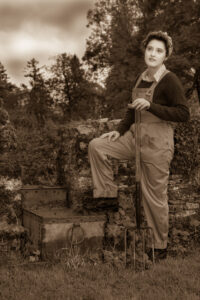
Daphne was a Devonshire Land Girl, who became an accomplished Rat Catcher in WW2. And now she will become immortalised in the next Longest Yarn 2 Project for 2025
The “Longest Yarn 2 – Britain at War”, a knitted display by knitters and groups from all over the UK and indeed around the world, starts its journey around Britain in April, 2025. At the end of May it can be seen in Plymouth and Liskeard. Following on from last year’s Longest Yarn 1 featuring D Day, this year’s project is another knitted display of some 80 boards , depicting activities of WW2 up to VE Day- between September 3rd 1939 to 8th May, 1945, which was VE Day. The LY2 will also be accompanied by knitted life-size characters from all the wartime services , from a spitfire pilot to our Land Girl Daphne.
And so to Daphne..
Young Daphne Hedges came to Devon during WW2. And her life and story will feature in events to mark the 80th Anniversary of VE Day in 2025 . As part of the LY2 project, a life sized, knitted, statue of Daphne will tour the UK within the display.

Becks Pearson , an ex Royal Navy Officer, has devoted her spare time to tracing surviving Land Girls, who were billeted in Devon in WW2. And so she is helping preserve memories of their lives for future generations. At the height of WW2, some 1700 Land Girls came to Devon. These girls took on all kinds of jobs aligned to feeding the country, whilst soldiers were at war – many roles the girls would never have thought within their ability.
There was Grace Dray, still living in Bovey Tracey at 94, who swapped sedate office work for tiring farm labour, but “loved every minute of it”. Meanwhile Ruby Terry found herself milking 50 cows twice a day. Most Land Girls had never even seen a cow before coming to Devon.

There are perhaps 7 or 8 ladies still living, most in their 90’s, who worked as Devon Land Girls.
Today the story stops at Daphne Hedges. She moved to Devon from Suffolk, firstly staying in Heavitree, near Exeter, with a Mrs Rice. Later Daphne moved to Ivybridge, Kingsbridge and Tiverton, before back to Suffolk.
The task of rat catching became vital in the war years – millions of tonnes of food were lost prior to pest control. Now saving food commodities was vital.
In May 1945 there were around 100 Land Girls trained to catch rats in Devon. They were taught to first feed the rats and tempt them into extermination afterwards. Crazily unexpected, but vital. The rat catching Land Girl provided many benefits – saving vermin from eating valuable grains, hence more was available to sow in fields for crops, or feed to stock, or flour and food production. ….
Such was the importance attached to rat catchers that competitions were even held for the greatest numbers and sizes of rats caught. The largest rat caught by a Land Girl was some 19.5 inches.

Symbolic of Daphne’s Land Girl role, Becks and the LY2 project put out an appeal for knitters and crochet enthusiasts at the end of 2024, to make 500 rats as part of the display.
The project aim is to showcase Daphne’s unlikely wartime role; a knitted portrayal of this young lady, in Land Girl uniform , with rats spewing from her pockets. Later, these hand crafted rats will be sold to raise money for veterans’ charities.
Many people have contributed to the call to rat – action, including WI’s from Bishopsteignton, Kennford and Dawlish, and also 98 year old Land Girl Maud Shires who has knitted around 55 rats.

For keen knitters, there is still a need for more rats to be knitted or crocheted – in colours of black, grey , white or brown , with a good length of tail – for hanging up on the display!
I’m going to visit this display when it pops up in Devon , to marvel at the Land Girls and the passion of the knitters creating Daphne and friends.